Tag: USA

  • Sound Move: My Thoughts on the Enterprise Initiative

    This is Post 2 of my Seattle Transit Series: Sound Move

    Sound Move is produced in collaboration with CreativeSystems of America. An independently-owned and operated collective, CreativeSystems of America aims to amplify voices of the American people.

    If you’ve been keeping up with the latest in Seattle transit news, you’ll know about Sound Transit’s record-breaking $34 billion shortfall. A shortfall of this size will be devastating to Sound Transit, undermining their potential capability to complete voter-approved Sound Transit 3 projects. Sound Transit is currently reviewing the Enterprise Initiative, a cost-cutting plan to re-work Sound Transit’s finances.

    In this initiative, there are a bunch of projects that Sound Transit is planning on deferring or reducing the scope of. This post is a reaction of sorts – answering the question of “Is this worth the deferral?”

    Link Light Rail to Tacoma Dome

    Although I understand why this project needs to get built, I can also see why this project could be deferred for a future phase. Tacoma to SeaTac trips are the main reason why this line should exist. In my mind, upgrades and improvements to Sounder S Line would be a much better investment, as the line links Tacoma to Seattle that makes much more sense. Link Light Rail would take much longer to get to Seattle, and I don’t know if it’s worth that investment. This section would also see very little ridership.

    In a political sense, this project is highly unlikely to be deferred. Pierce County subarea voters have received very little improvements outside of the T Line extension, so this project will “recoup” Tacoma’s investment into regional transit.

    Link Light Rail to Everett

    This project, despite the abysmal rider projections is sorely needed for regional connectivity. The existing options, including Sound Transit Express lines and the Sounder N Line are relatively insufficient to support future rider growth. Snohomish County got its first light rail line back in 2024, and a connection to Everett would be a great investment to maintain regional connectivity. No complaints here, other than the line’s strange routing.

    Link Light Rail to Issaquah and SOuth Kirkland

    This line would be an easy offshoot from the 2 Line as long as they follow the freeway routing. Although the line would be a lot more valuable if Kirkland wanted the line, it’s decently needed for more interconnectivity in East King Subregion. I doubt that it would be as impactful as Stride BRT, but as it stands I’m happy with the delay.

    Link Light Rail to West Seattle

    This branch would bring pretty decent ridership for Link despite being so short, but I think Avalon should be put back onto the map to provide better connections to Burien or White Center. Alaska Junction is already served by the RapidRide C Line and the Link conection would be beneficial for the area.

    Link Light Rail to Ballard

    This is a pretty big mistake. Ballard Link, including the Second Downtown Tunnel is a valuable opportunity to provide better connections in a transit-dependent area. Building the full link out to Ballard would provide way better regional opportunities for riders outside of the North King Subarea, as they can use Link as a part of a true transit corridor in Seattle. Although the costs are high, this one project will boost regional opportunities much further than a light rail line to Issaquah.

    So far, the subarea structure of Sound Transit essentially means that this project is very unlikely to be fully funded by ST3, despite the fact that it is guaranteed to provide the best value for money. I understand that the political will to build this project is very much alive, but Seattle’s interests remain eaten up by the rest of the board that must advocate for their areas.

    In the meantime, the proposal to build to Seattle Center would still benefit South Lake Union, so I’m happy that at least a stub line is being built. My fear is that the stub will exist in a Wilshire/Western-esque limbo of existence. My hope is that they’re able to prioritize the full buildout to Ballard before the political motivation to build it disappears.

    Graham Street Station (Infill)

    Not a fan of this deferral. Subjectively, South Seattle has been f*cked over by the Link system because of this at-grade section. Despite that, it has still managed to prosper and maintain a lot of its character. Graham Street has been requested for years by the community, and would fill a particularly important gap along MLK Jr. Way. It’s a pretty “cheap” station (estimated at US$214M) that would greatly benefit the community. Seattle continues to alienate some of the city’s most marginalized neighborhoods, and the deferral of this station is a reminder of that fact. A proposal by Seattle Mayor Katie Wilson has proposed a “last-in” funding mechanism that would restore funding for this station, and I really hope it passes.

    Boeing Access Road Station (Infill)

    If I’m honest, I’d rather see this station cancelled outright. For the estimated cost of US$425-475M, this station would serve basically nothing and has very little development potential. This is already an incredible waste of money, and it should be removed from the schedule altogether.

    Sounder Improvements

    A whole list of Sounder improvements, including capacity improvements for Sounder South, and an extension to DuPont are all proposed to be deferred. While it would be nice, the extension to DuPont is less of a priority than the Sounder South capacity improvements. Hourly frequencies between Tacoma and Seattle would be a dream, but I doubt BNSF would be co-operative for that amount of traffic.

    Link Light Rail to Tacoma Community College

    I don’t know much about the T Line unfortunately, but the T Line’s Hilltop Extension has proven to be of great value to the City of Tacoma. Since the main priority for this line is economic development, keeping it on the table but extending the debt priority is probably the best outcome for this project.

    What’s Next?

    As of the date of publication, the Sound Transit Board is voting to approve or amend the Enterprise Initiative today (Thursday, 28 May). My hope is that we can find ways to lower soft costs and keep the transit momentum going in the Puget Sound. Seattle is on a great run with building and developing transit, and this momentum needs to be harvested for the next generation of projects.

    Further rEading

    Substitute Resolution No. R2026-11

    Graham Street Station and the Failure of the Enterprise Initiative

    How to Finish ST3 Sooner (Without Raising Taxes)

  • Sound Move: Initial Thoughts on the Crosslake Connection

    This is Post 1 of my Seattle Transit Series: Sound Move.

    Sound Move is produced in collaboration with CreativeSystems of America. Providing voices to American communities and peoples.

    On March 28th, 2026, Seattle welcomed a long-awaited and overdue rail connection – the Crosslake Connection. The 7 mile, 2 station extension connects a fragmented Link Light Rail system – giving Redmond and Bellevue a one-seat ride into Downtown Seattle, and onto Lynnwood, SeaTac / Airport, and Federal Way.

    Coincidentally (and not planned at all!), I was also in Seattle on March 28th, 2026! Waking up at 6am, I decided to show up for the opening events to celebrate such a monstrous development in the Puget Sound.

    Opening Events

    The opening events were held across from the new Judkins Park station at Sam Smith Park. Living in Toronto, I’ve never really experienced a transit opening, but Seattle really did it up! The whole park was set up with community tents, vendors, and even transit advocate groups! The Cascade Cycling Club even set up a bike valet.

    Thankfully, Seattle not only wants to throw a party, but people will show up in droves for it. It was already packed at 8 AM which is when the actual event starts. What did I expect in a city where the main activity is hiking and running?

    Alas, there was no running or hiking this day, unless you wanted to trample a bunch of people. The main event was a bunch of speeches from important people. I can now tell people I saw the Governor of Washington, the Mayors of Seattle, Bellevue, Redmond, Mercer Island, and a United States Senator talk less than 50 feet away from me.

    The other events included a stamp competition – get a commemorative stamp at four stations (Chinatown–International District, Judkins Park, Mercer Island, South Bellevue) and get a bucket hat. Fortunately (or unfortunately), there were literal quarter-mile lines to get on the train, so it was not possible for me.

    Fortunately for me, this event was SWAG central. I love free swag, even though it’s actually so useless. I mainly got a bunch of stickers, but also the limited edition, corporate sponsored (thanks Microsoft!) Orca Card. Transit Cards are great souvenirs to collect because they’re 1. Useful and 2. A very small souvenir from the city. I will cherish this card forever.

    After the speeches and the community tents (where I talked to so many great people), I headed over to Exit A of the station where the ribbon cutting would occur. After a mile-long parade of delegates, the line was finally open!

    The Ride

    For me, my ride started at Bellevue Downtown station. After the opening events, I had other plans in the ID to attend to, so after lunch I boarded a bus (King County Metro 271) to ride the actual train. I took a detour to Downtown Redmond (new mileage I haven’t riden yet), and headed back down to South Bellevue to ride the new segment.

    Honestly, there was very little to say about the actual ride. It went as smooth as you’d hope. The train got up to max speed (55mph) as it crossed over I-5 and onto a viaduct to Mercer Island. The train then crossed the Homer M. Hadley Memorial Bridge at 55 mph, making it the first permanent light rail line on a floating bridge. It was actually pretty cool engineering too. The views were sick but honestly exactly the same as the views I got walking across the bridge.

    The best part however, is the fact that it takes 10 minutes from South Bellevue to C-ID. It’s a life changer getting between the Eastside and Seattle. The bus I took to Bellevue took me around 40 minutes. I cannot say enough words how great this line will be for Seattleites.

    Overall Thoughts

    With the Crosslake Connection finally open, and high-quality rapid transit finally spanning the Puget Sound, the Crosslake Connection is the root turning Seattle into a true, transit-friendly city.

    I’m not here to talk about Sound Transit 3 and why it’s become a fiscal disaster, but I can already see how people are taking this new line and turning their attention towards building more high-quality transit in the Puget Sound. While I was there, I was invited to many open consultations and events to save light rail in West Seattle, Ballard, and even Issaquah of all places. I’ve never seen a city change so quickly and embrace transit. Build it and they will come!

  • My latest obsession is Connecticut

    Spring has arrived, and so has a new state to obsess over. This state, Connecticut was brought to you by my viewership of the hit CW show, Gilmore Girls. You may have guessed at this point that the show takes place in Connecticut.

    Facts I knew about Connecticut before my obsession

    • It’s one of two states in New England that I’ve never been to (please leave your guesses to which the other state could be)
    • The capital of Connecticut is Hartford
    • The governor is Ned Lamont
    • It is one of the few states with a statewide transit system (the other ones being Delaware, Rhode Island, Vermont [kinda], New Jersey)
    • Other cities I know include Stamford (thanks to the Office (U.S.), New Haven (Yale), New London)

    What intrigues me about Connecticut

    • It’s one of the few states that does not have upper-level administrative regions (counties). Counties were abolished in the 1960’s, and cities take on the responsibilities traditionally left up to the counties
    • It’s the eastern version of New Jersey: sandwiched between two major metropolitan areas with an identity that persists with no discernible traits.
    • New England: I love New England. It’s a magical part of the country that I would love to explore more. It has the history, the rural charm, and a lovely mix of mountains, ocean, and forests in between. It’s a magical place to experience, and Connecticut is smack dab in the middle of it.
    • Size: I like smaller states. They feel more intimate. This is not a joke about anything, I am serious.
    • AmTrak: It’s a state that many people pass by on their way to other destinations (Boston, New York). Connecticut should be a place people want to stop at.

    Overall, I hope people can join me Connecticut-maxing this spring. If you enjoy the concept of Connecticut do let me know!

  • Apathy is never hot!

    The least interesting people I know are apathetic.

    People need to start sharing more of their opinions! I don’t really understand why in the era of TikTok, where we’re given a microphone to voice our concerns to people that those voices become very low. I’m not saying you need to go as drastic as sharing all of your thoughts on TikTok, but very few people feel even curious enough to learn about things they don’t even know about.

    The way we (society) is choosing to outsource what we’re curious about to an algorithm is frankly very concerning and indicative of our convenience culture. I implore people to take a 20 minute (1 mile) walk around their neighborhood, with just a notepad and a pen. Write down anything that interests you as you walk around and do some research when you get home. Frankly, I want life to be more curious and my hope is that others are curious too.

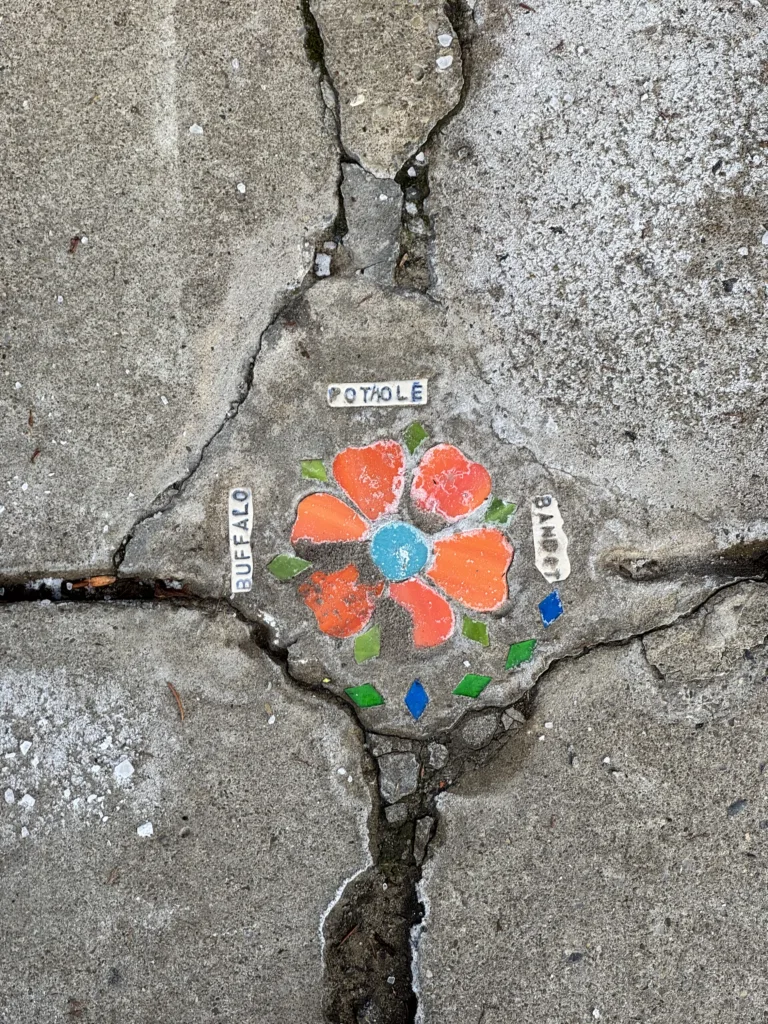
    The BUffalo Pothole Bandit

    This was something I took a photo of because I was curious about it! I stumbled upon it during my stroll on Elmwood.

    The story of the Buffalo Pothole Bandit started during the pandemic. A man who was enraged with the Supreme Court’s decision to overturn Roe v. Wade (1973) filled a bunch of potholes around Buffalo’s Elmwood Village neighborhood with “F**K SCOTUS” messages. There’s also another story where he just twists his ankle and gets enraged enough to fill it with cement and art.

    What really interests me about this character is his whimsy and his ability to use something as simple as basic wear and tear as an opportunity to make the city a more beautiful place. This is an example of someone who shares his passion with the world, and the world becomes a better place because of it. I’m not a artistic person but I would love to contribute something similar to my community!

  • Three reasons why you need to make Buffalo your next stop on a All-America trip

    This post has no affiliation with the following organizations: The Corporation for Travel Promotion d.b.a Brand USA, New York State Department of Economic Development (ILOVENY), Erie County Economic Development (Visit Buffalo!), City of Buffalo.

    The locals

    Buffalo is the “City of Good Neighbors”. It’s also the “Nickel City”, but I digress. The people in Buffalo are generally very good and welcoming, and there’s a surprisingly amount of diversity in the metro area. It’s a really great city if you want a place that fosters a sense of community.

    A city with a community

    One of the main draws of Buffalo is the fact that it’s still a city, with big city amenities. You still have your apartments, your walkable neighborhoods, your Apple Store. It even has its own subway. What it lacks however, is the big-city traffic you’ll find in most major cities. While it has that hustle and bustle, it doesn’t make you feel like you’re stuck in it.

    Proximity to Nature

    Buffalo is surprisingly a city very close to nature. You have Niagara Falls just 20 minutes away, but also a huge network of state parks in the region. South of Buffalo, you have access to rolling hills and mountains of the Appalachians. Lake Erie hugs the city, and there’s plenty of access points in the area, including the Outer Harbor, a lakefront retreat in the middle of Buffalo’s abandoned industrial past.